

Fast, Reliable Storm & Disaster Restoration Across Mendota Heights
Storm damage in Mendota Heights rarely announces itself politely. It’s a sump pump that quits during a March thaw, a cast-iron drain line that cracks under frozen ground, or an ice dam that quietly feeds water into your attic for a week before the ceiling stain shows up. Wade’s Restoration gets to Mendota Heights fast, and we know this terrain better than most. The bluffs, the ravines, the 1950s basements with original drain tile: these aren’t surprises to us. They’re the job. Call (888) 690-6095 and you’ll get Wade or someone on his crew, not a call center. We answer 24 hours a day, and we do not put you on hold while your basement keeps filling.
When storm water is moving through your house, every hour matters. We head out immediately, with professional-grade extraction equipment from Dri-Eaz and Phoenix already on the truck. Wade Ferris answers his own phone. That’s not a slogan; it’s how he’s run the business since 2007.
Why Wade’s Restoration of Minneapolis Is Mendota Heights’s Preferred Storm & Disaster Restoration Company
People in Mendota Heights tend to ask around before they let anyone into their house. We understand that. Wade publishes his name, his address, and his license number. You’ll see him at the hardware store on a Saturday. That’s the oldest accountability mechanism there is, and it still works. Our Storm & Disaster Restoration team has handled flooded basements, storm-soaked attics, and sewage backups in nearly every corner of this city, from the neighborhoods along Highway 13 to the bluff edges above Lilydale Regional Park. Wade’s crew is background-checked and uniformed, and every water, fire, and mold job carries our 90-Day Done Right Promise in writing. If it’s not done right, we make it right. One call brings Wade back.
We’re not a national chain. We live and work in the Twin Cities metro, and when you call for help in Mendota Heights, someone with local knowledge shows up. We know what a failed sump pump sounds like at 2 a.m. in a 1960s split-level near Dodge Nature Center. We know which ravine-adjacent properties cycle moisture into their foundations every spring. That kind of familiarity isn’t something you can train into a rotating cast of out-of-town techs.
Our Storm & Disaster Restoration Services in Mendota Heights
Storm Damage Cleanup
After a convective storm tears through Mendota Heights, homeowners deal with downed branches, scattered debris, damaged siding, and water that found its way inside through a dozen small openings. We handle the full cleanup: debris removal, structural drying, and a written scope of what needs repair before any work continues. You’ll know exactly what we found and what it costs before we touch a single stud.
Flood Damage Restoration
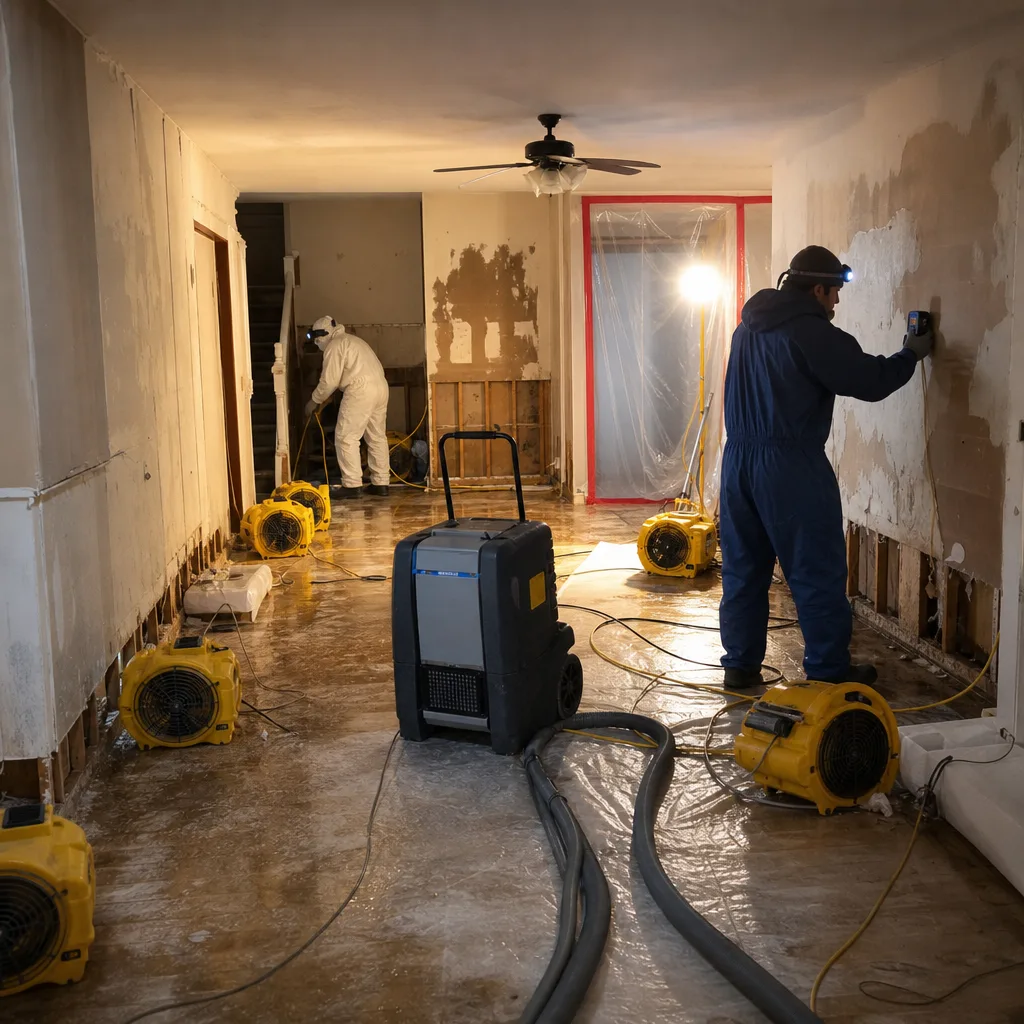
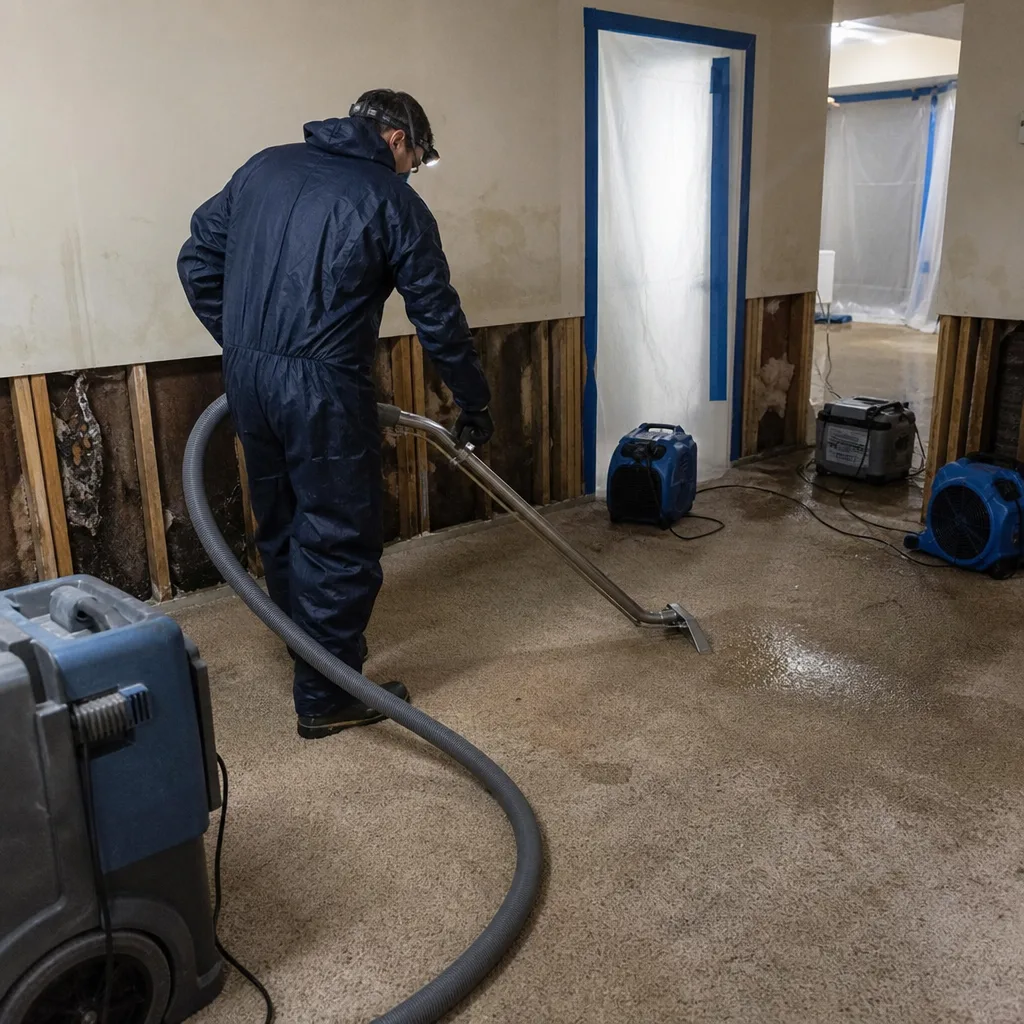
Mendota Heights sits on limestone bluffs above the confluence of the Minnesota and Mississippi Rivers, with wooded ravines cutting through residential areas. That topography funnels surface water and spring snowmelt directly toward foundations, concentrating hydrostatic pressure against basement walls in a way you don’t see in flatter Dakota County suburbs like Eagan. Our Storm & Disaster Restoration in Mendota Heights flood response uses Dri-Eaz dehumidifiers and Phoenix air movers to pull moisture from concrete, framing, and flooring, then we document moisture readings daily and hand you the full log when the job is done. Almost nobody else does that.
Emergency Board-Up
When wind or fallen limbs breach a window or door in Mendota Heights, you need that opening secured before the next rain blows through. We board up with plywood cut to fit, tarp the roof if needed, and document everything with photos for your insurance claim. Wade deals with the adjuster directly, so you’re not stuck relaying messages between two sides.
Roof Tarping
Minnesota’s freeze-thaw cycle is brutal on the pitched roofs standard across Mendota Heights. Ice dams form after late-winter snow, forcing water under shingles and into attic assemblies before you ever see an interior stain. We tarp damaged roof sections fast, using heavy-duty poly secured to prevent further water entry while you plan permanent repairs. The goal is to stop the bleeding, not to sell you a roof.
What happens when you call
- 1
A real person answersNo phone trees - you reach a local pro.
- 2
You get an upfront price rangeHonest numbers before anyone is dispatched.
- 3
A background-checked tech heads outLicensed & insured, dispatched right away.
- 4
You approve before work beginsNothing starts until you say go.
Trusted Brands We Service in Mendota Heights
We run professional-grade equipment on every job in Mendota Heights: Dri-Eaz dehumidifiers and air movers, Phoenix drying systems, Injectidry for hard-to-reach cavities, and B-Air filtration units. These are the names serious restoration contractors use, and we keep them maintained and ready. Our IICRC-certified techs and RIA-affiliated team know how to run this equipment properly, which matters more than most homeowners realize. A dehumidifier set wrong is just an expensive fan.
Common Storm & Disaster Restoration Problems We See in Mendota Heights Homes
The houses here tell a consistent story. Most were built between the 1950s and early 1980s, which means original drain tile, cast-iron drain lines, and waterproofing systems that are now 40 to 70 years old. Add the bluff-and-ravine terrain, and you get a predictable set of failure modes. Here’s what we walk into most often:
- Hydrostatic pressure against basement walls: The limestone bluffs and wooded ravines channel snowmelt and storm runoff straight toward foundations. When the ground is frozen in late winter, that water has nowhere to go except against your basement walls, and 60-year-old drain tile wasn’t built for the load.
- Cracked cast-iron drain lines: Homes from the 1950s through the 1970s often still have original cast-iron waste lines under the slab. Freeze-thaw cycles crack them over decades, and during a heavy convective storm, sewage backs up into basements. If you smell it after a rain, that’s usually the cause.
- Ice dams on pitched roofs: Mendota Heights has plenty of ranch and split-level homes with standard pitched roofs. Late-winter snow melts, refreezes at the eaves, and forces water backward under shingles. By the time you see a ceiling stain in the living room, the attic insulation has been wet for a week.
- Sump pump overload near ravines: Properties abutting the wooded ravines near Dodge Nature Center and the bluff edges above Lilydale Regional Park sit at the bottom of natural drainage corridors. One heavy rain or rapid snowmelt, and the sump pump simply can’t keep up. Homes there often show chronic efflorescence and spalling on poured-concrete walls that looks like fresh water damage but is actually a repeating moisture cycle.
Pricing for Storm & Disaster Restoration in Mendota Heights, MN
Storm damage repair costs in Mendota Heights depend on what actually happened, but here are real numbers from work we’ve done here. Emergency board-up and basic roof tarping typically runs $450 to $900 depending on the size and accessibility of the damage. Flood extraction and structural drying for a basement with 2 to 4 inches of water usually lands between $2,800 and $5,500, including equipment, daily moisture monitoring, and the full documentation log. When an ice dam has soaked an attic assembly, expect $3,200 to $6,800 for drying, insulation removal, and sanitizing, before any reconstruction. Sewage backup from a cracked cast-iron line is the priciest category: $4,000 to $9,000 once containment, disposal, and sanitizing are included.
Wade gives you a written scope and a firm price before work starts. No vague promises, no change orders that appear out of nowhere. There’s no trip charge inside our own county, and we offer a permanent Senior & Veteran 10% discount. Call (888) 690-6095 for an exact quote. Estimates are free, and Wade will tell you straight if a smaller fix is all you need.
We Also Serve Cities Near Mendota Heights
Wade’s Restoration covers all of Mendota Heights, including the 55120 ZIP code and the neighborhoods along Highway 13, Highway 110, and the bluff roads above the river. We also serve Eagan, Inver Grove Heights, Saint Paul, and South Saint Paul. Dispatch and scheduling are coordinated from our Minneapolis-St Paul office, and crews serve Mendota Heights locally.
Key Takeaways for Mendota Heights Homeowners
- Storm damage in Mendota Heights is usually about water, not wind, because of the bluff-and-ravine terrain.
- Original cast-iron drain lines and 40-to-70-year-old drain tile are the weak points in most houses here.
- Ice dams are a recurring roof threat every late winter, even on homes with no visible exterior damage.
- Wade Ferris answers his own phone, 24/7, and every restoration job carries the 90-Day Done Right Promise in writing.
- Mendota Heights basements flood most often during spring thaw and heavy convective storms, and response speed determines how much can be saved.
Serving Mendota Heights, MN - Our Local Coverage Area
We’re based in the Mendota Heights area and know this community well. Use the map below to see our service coverage - if you’re nearby, we can almost certainly help.
FAQs - Storm & Disaster Restoration in Mendota Heights
That white crust is efflorescence, and in Mendota Heights it usually comes from hydrostatic pressure pushing groundwater through poured-concrete walls. The limestone bluffs and wooded ravines channel surface water and snowmelt toward foundations, and when the ground saturates, water seeps through micro-pores in the concrete, carrying dissolved minerals that dry into that crusty white film. The flaking, called spalling, means the concrete surface is being slowly damaged by repeated moisture cycling. It’s not a fresh storm leak; it’s a chronic drainage problem at the foundation level. Call (888) 690-6095 and Wade can tell you whether you need drain tile retrofit, exterior waterproofing, or something simpler, with a written scope before any work begins.
It raises it significantly. Homes on the bluff edges and near the wooded ravines sit in natural drainage corridors where surface water and snowmelt concentrate. During a rapid March thaw or a heavy convective storm, sump pumps in those areas can cycle continuously or fail outright from overload. When the pump quits, the basement fills in under an hour. One of our crews responded to a 1968 split-level near the ravines by Dodge Nature Center after a fast snowmelt overloaded the sump pump and sent six inches of water across the basement. We extracted with Dri-Eaz and Phoenix units, then traced chronic efflorescence on the poured-concrete walls to failed original drain tile, not a fresh leak, and recommended a retrofit before the next thaw.
Treat it as a biohazard and get professional help immediately. Cast-iron lines from the 1950s through the 1970s crack under decades of freeze-thaw stress, and during heavy-load storms, sewage backs up through the floor drains into the basement. Do not enter the water without proper protective gear. Call Wade’s Restoration right away at (888) 690-6095. We handle containment, sewage extraction, sanitizing, and full documentation for your insurance claim. Wade deals with the adjuster directly, so you’re not the one explaining technical details to a claims rep.
In Mendota Heights, that’s almost always an ice dam. Snow melts on the warmer upper roof, runs down to the colder eaves, and refreezes into a ridge of ice. Water then backs up behind the dam and seeps under the shingles, soaking the roof deck and attic insulation while the exterior looks fine. The first sign is often a water stain on a ceiling or dampness in the attic, weeks after the ice dam formed. Roof tarping and targeted drying are the immediate fix, but Wade will also tell you whether your attic ventilation or insulation needs addressing so it doesn’t happen again next winter. Call for an inspection; the estimate is free.
Look at where the water is coming from and what the walls look like. Fresh storm water usually enters through obvious points: window wells, floor drains, the sump pit, or cracks. Chronic foundation issues show up as repeated efflorescence, spalling concrete, or dampness in the same spots regardless of recent weather. In Mendota Heights, properties near the ravines and bluff edges often have both: a storm triggers the flood, but the underlying problem is failed drain tile or inadequate waterproofing that’s been there for years. Wade’s crew takes moisture readings every single day and hands you the full log at the end, so you can see exactly what was wet, how wet, and how fast it dried. That data settles the fresh-versus-chronic question without guesswork.
Call Wade’s Restoration for Storm & Disaster Restoration in Mendota Heights, MN
When your basement is filling or your attic is soaked, you don’t need a call center. You need Wade. He answers his own phone, he knows Mendota Heights, and he’ll be on the road inside the hour. Call (888) 690-6095 for a free estimate, no trip charge inside our county. If another company handed you a written estimate, bring it in. Wade will give you a free second opinion. And if you’re over 55 or a veteran, ask about the permanent 10% discount. One call, one person, one written promise: if it’s not done right, we make it right.
Written by Wade Ferris, Owner at Wade’s Restoration of Minneapolis, serving Mendota Heights since 2007.