
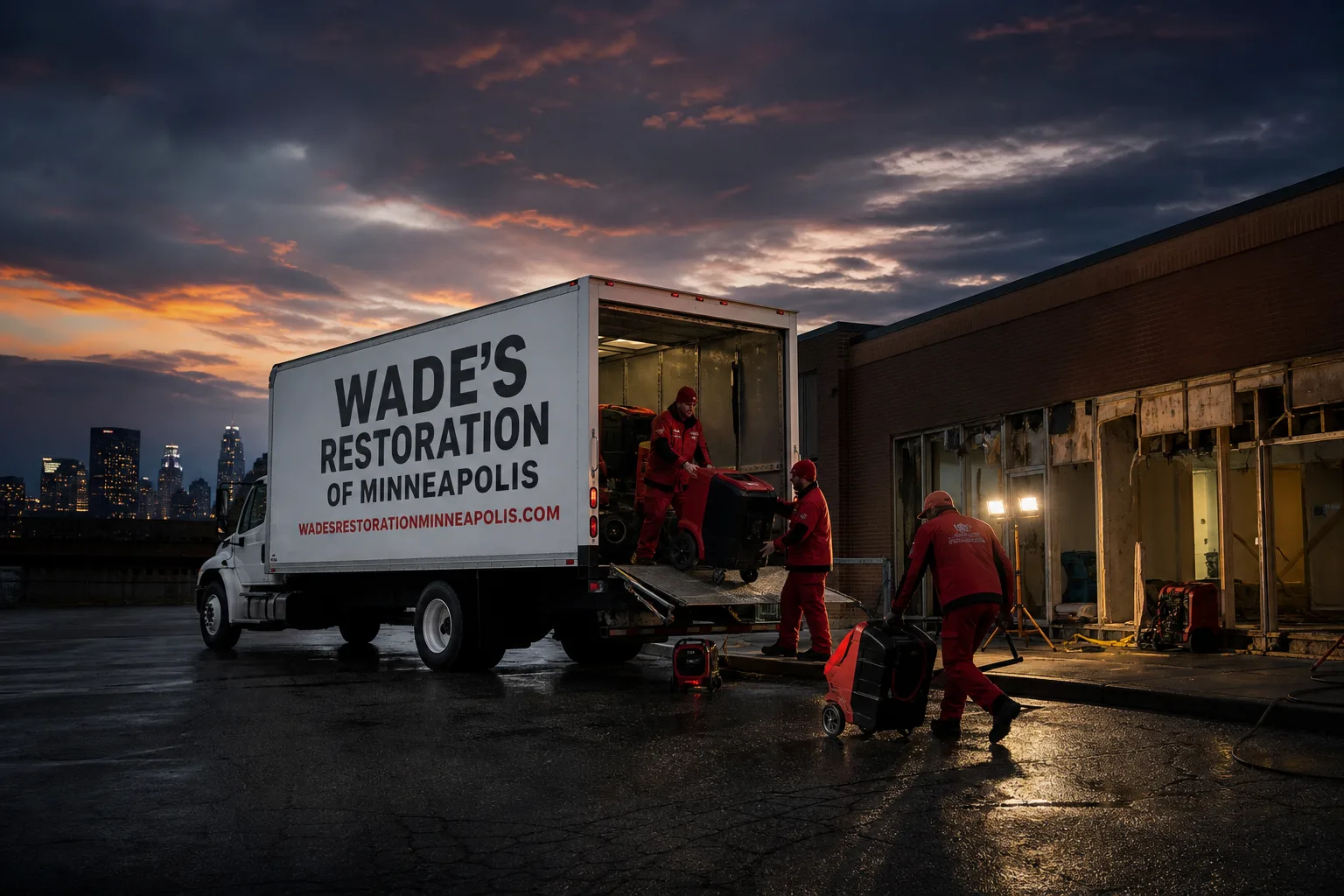
Fast, Reliable Storm & Disaster Restoration Across Ham Lake
Storm damage in Ham Lake doesn’t wait for business hours, and neither do we. When wind tears shingles off your roof or spring melt pushes water into your basement, you need someone who knows the difference between a city-sewer flood and a saturated drainfield on a shoreland lot. That’s the kind of local knowledge that changes how a job gets done. Our Storm & Disaster Restoration team heads to Ham Lake the moment you call, with extraction equipment ready to run. Call (888) 690-6095 and you’ll get Wade or a member of his crew on the line, not an answering service.
Key takeaways for Ham Lake homeowners:
– On lakeside and wetland-adjacent lots, storm flooding often means groundwater and septic saturation happen at the same time, and treating one while ignoring the other leaves contamination behind.
– Most Ham Lake basements date from the 1970s through 1990s and lack modern waterproofing, so chronic seepage is more common than one-time acute floods.
– The heavy oak canopy shading many Ham Lake roofs makes ice dams worse, and a tarp job that misses the shaded sections won’t stop water feeding under shingles.
– We run one-trip extraction with professional-grade equipment even on long gravel driveways, because drying mid-century basements fast is the whole game.
Why Wade’s Restoration of Minneapolis Is Ham Lake’s Preferred Storm & Disaster Restoration Company
Wade Ferris has spent over 29 years working in restoration, and he built this company in 2007 on a simple idea: put your name on the truck, publish your address, and answer your own phone. That’s what Ham Lake homeowners get when they call. Wade doesn’t send a crew you’ve never met and hope for the best. He’s on the road himself, and he’s been on enough Ham Lake properties to know what a high water table does to a 1980s block basement after a heavy rain. Ask anyone on your street about the neighbor who showed up at midnight with a Dri-Eaz unit and didn’t leave until the water was gone. Wade’s reputation in Anoka County was built one flooded basement at a time.
Every water, fire, and mold restoration job comes with the 90-Day Done Right Promise stamped in writing. If it’s not done right, Wade makes it right. No fine print, no callback runaround. His crew is background-checked and uniformed, and they carry IICRC certification along with professional-grade equipment from Dri-Eaz, Phoenix, and XPOWER. Calls to Ham Lake are answered by a live person 24/7, which means when a storm rolls through at 2 a.m., Wade heads out. Not a call center. Not a queue. Here is my cell, is the way he puts it.
Our Storm & Disaster Restoration Services in Ham Lake
Storm Damage Cleanup
Wind damage in Ham Lake usually means downed limbs, torn siding, and shingles scattered across a lawn shaded by mature oaks. We clear debris, assess what’s structural versus cosmetic, and document everything for your insurance adjuster. On Ham Lake’s wooded lots, a single storm can drop enough branches to block a driveway and tear a hole in the roof at the same time, and we handle both in one trip.
Flood Damage Restoration
This is where Ham Lake separates the experienced restorers from the ones who learned on city-sewer lots in Blaine. On lake-adjacent streets near the namesake lake itself, a heavy rain event can produce both a flooded basement and a saturated drainfield. Wade’s crew knows to test whether the water is groundwater seepage or septic backflow before extraction starts. We run Dri-Eaz and Phoenix equipment hard on the first visit because 1970s and 1980s poured-concrete basements don’t forgive slow drying. Moisture readings get logged every day, and you get the full log at the end. Almost nobody in this trade hands over that paperwork. Wade does.
Emergency Board-Up
When wind or a falling limb takes out a window or a door, an open house is an invitation to more damage and unwanted visitors. We board up fast, and we do it so the temporary fix holds until your insurance adjuster and rebuild crew can do permanent work. On Ham Lake’s acreage parcels, where homes sit well back from the road and neighbors can’t watch the property, a quick board-up matters even more.
Roof Tarping
A tarp over torn shingles only works if it’s placed correctly, and on Ham Lake lots with heavy tree canopy, “correctly” means accounting for shaded roof sections that melt snow unevenly and feed ice dams for days after the storm. We tarp the obvious damage and the sections where uneven melt keeps pushing water under shingles. Short-term thinking on a tarp job turns a small repair into a ceiling collapse by March.
What happens when you call
- 1
A real person answersNo phone trees - you reach a local pro.
- 2
You get an upfront price rangeHonest numbers before anyone is dispatched.
- 3
A background-checked tech heads outLicensed & insured, dispatched right away.
- 4
You approve before work beginsNothing starts until you say go.
Trusted Brands We Service in Ham Lake
We stock and run professional-grade equipment from XPOWER, B-Air, and Injectidry, and we service the same brands in Ham Lake homes that already have restoration equipment or sump backups installed. If your basement has a XPOWER pump that failed during a storm, Wade’s crew can diagnose it on the spot and get extraction running the same day. We keep common parts on the trucks so a Ham Lake job doesn’t stall waiting on a parts warehouse. One trip matters when your basement is holding water.
Common Storm & Disaster Restoration Problems We See in Ham Lake Homes
– Chronic seepage in 1970s-1990s basements: These homes were built before modern waterproofing membranes and weeping-tile upgrades became standard. After every heavy rain, water finds the same path through the walls or floor, and repeated wetting leads to mold that most homeowners don’t notice until the smell spreads upstairs.
– Septic backflow mistaken for groundwater: On acreage lots with private septic systems, a flooded basement can be sewage backflow, not just rain seepage. Crews trained on city-sewer lots treat everything as groundwater, leave contamination behind, and call it done. Wade’s crew tests first.
– Ice dams made worse by tree canopy: Ham Lake’s mature oaks shade roof sections unevenly. Snow melts faster on the sunny side, refreezes at the eave, and water backs up under shingles. A tarp job that ignores the shaded sections won’t stop the leak.
– Long gravel drives that slow equipment access: Many Ham Lake homes sit far back from the road. National outfits send a truck that can’t handle the driveway or skip the heavy extraction gear on the first trip, forcing multiple return visits that delay drying. We bring the heavy equipment the first time.
Pricing for Storm & Disaster Restoration in Ham Lake, MN
We Also Serve Cities Near Ham Lake
If you’re just outside Ham Lake, we cover the surrounding communities too. Andover, Blaine, West Coon Rapids, and Champlin are all in our local service area, and the same crew that handles Storm & Disaster Restoration in Ham Lake will be the one on your doorstep. Call (888) 690-6095 from any of those cities and Wade heads out directly.
Serving Ham Lake, MN - Our Local Coverage Area
We’re based in the Ham Lake area and know this community well. Use the map below to see our service coverage - if you’re nearby, we can almost certainly help.
FAQs - Storm & Disaster Restoration in Ham Lake
My Ham Lake basement flooded after a storm, but my house is on a septic system. How do I know if the water is groundwater or sewage backflow?
Groundwater seepage is usually clear or slightly muddy and comes from walls or floor cracks, while sewage backflow has a distinct odor, is often dark, and may come up through floor drains. On Ham Lake shoreland lots, the two can happen at the same time, which is why Wade’s crew tests before extraction starts. If you’re not sure, don’t pump it yourself and don’t run fans until it’s been assessed. Call (888) 690-6095 and we’ll determine the source and get the right equipment running.
Why do so many 1970s-1990s Ham Lake basements keep getting chronic seepage after heavy rain, even without a flood event?
Most basements in Ham Lake were poured before modern waterproofing membranes and weeping-tile systems became common. The clay-heavy soil that surrounds many Anoka County foundations holds water and pressures it against the walls. Once water finds a path through a crack or tie-rod hole, it keeps using that path every time the water table rises. Repeated seepage means repeated dampness, and dampness means mold. If your basement has that musty smell after every rain, call (888) 690-6095 for a moisture assessment and a written plan.
A windstorm tore shingles off my Ham Lake roof, and my lot has huge oaks shading half the house. Can that make ice dams worse later?
Yes. Shaded roof sections stay colder, so snow there melts more slowly and refreezes at the eaves, creating ice dams that push water under shingles for days or weeks after a storm. When we tarp a Ham Lake roof, we account for the shaded sections and the uneven melt patterns, not just the obvious tear. A tarp that misses those zones leaves water feeding the same leak all winter. We’ll inspect the full roof plane before we place anything.
My lakeside home flooded during spring ice-out, and the water came from the lake AND the basement sump. What should I do first?
First, cut power to the basement if outlets are submerged, and call (888) 690-6095 immediately. On lakeside Ham Lake properties, ice-out can push lake water onto low-lying lots at the same time that snowmelt overwhelms the sump pump. The critical first step is a quick assessment of whether it’s lake water, groundwater, or both, because that changes the drying plan and the insurance documentation. Wade’s crew can have extraction running inside the hour, and we’ll log moisture readings daily until the structure is dry.
I’m on a long gravel drive in Ham Lake and my basement flooded. Can your crew really do the whole job in one trip?
Yes. We bring the heavy extraction equipment, including Dri-Eaz LGR dehumidifiers and Phoenix AirMax units, on the first truck that leaves our yard. No second trip for gear that should have been there the first time. On a typical Ham Lake acreage property with a gravel drive, we arrive with everything needed for extraction and drying setup in the same visit. That speed matters on 1970s-1990s basements with no modern waterproofing, where every hour of standing water pushes moisture deeper into walls and flooring.
Call Wade’s Restoration of Minneapolis for Storm & Disaster Restoration in Ham Lake
If a storm has left your Ham Lake home with a flooded basement, a torn roof, or a septic concern, don’t wait for the damage to spread while you figure out who to call. Call (888) 690-6095 now and you’ll get a live person. Wade answers his own phone. He’ll tell you what to do in the next ten minutes, and then he’ll head to your door with the gear to start the job. Estimates are free. There’s no trip charge inside our own county. And every restoration job comes with the 90-Day Done Right Promise in writing. If it’s not done right, Wade makes it right. That’s the way it’s been since 2007.
To wade is what you do through a flooded basement at two in the morning, and it happens to be his name.
Written by Wade Ferris, Owner at Wade’s Restoration of Minneapolis, serving Ham Lake and surrounding Anoka County communities.