
Emergency Water Damage Restoration Near Me: What Minneapolis Homeowners Should Do First
If you have water coming into your Minneapolis home right now, shut off the water at the main valve, cut power to affected rooms at the breaker, and call a restoration company that answers with a live person. Most homeowners wait too long, and the difference between a $2,000 dry-out and a $20,000 rebuild is usually the first 90 minutes. If you’d rather not handle this alone, call Wade’s Restoration of Minneapolis at (888) 690-6095 and Wade will walk you through it over the phone while he’s on the road.
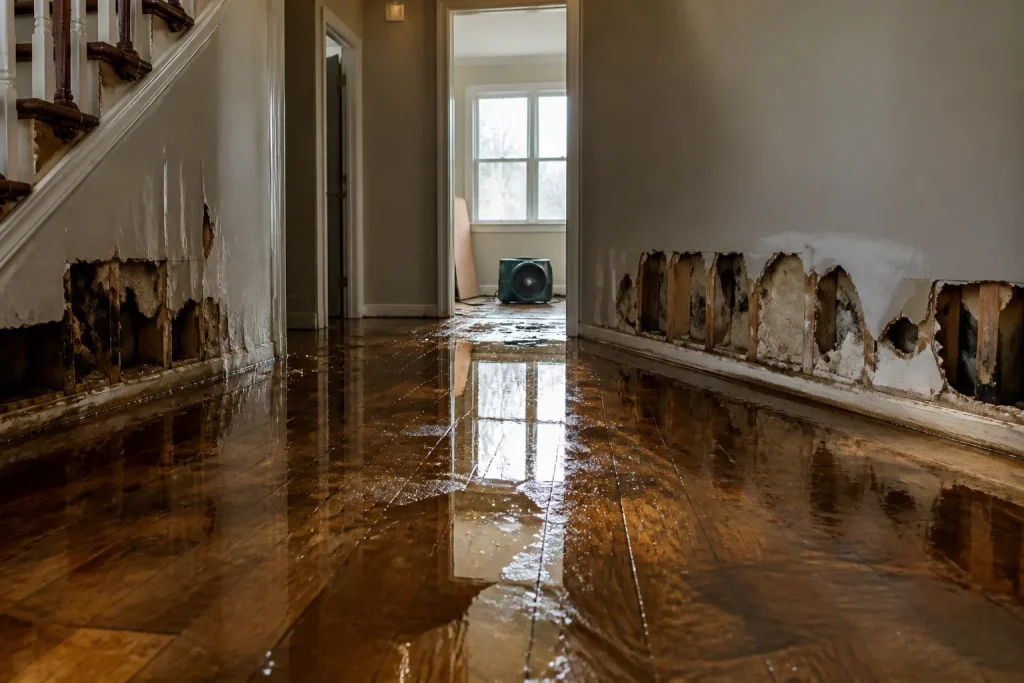
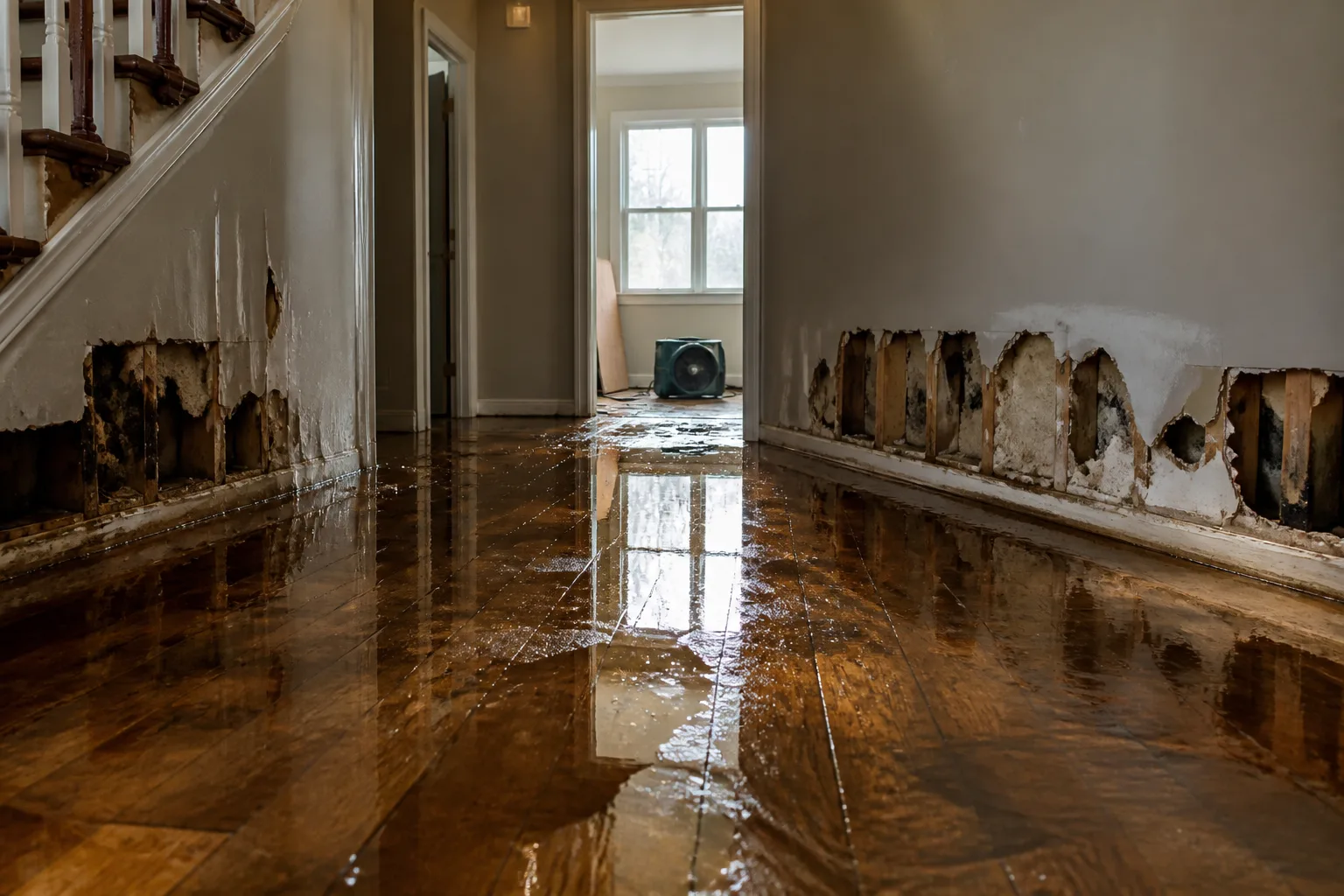
Here’s the part almost nobody tells you: the water you can see is not the water that destroys your house. It’s the water that wicks up into drywall, under baseboards, and into the subfloor. In Minneapolis, where basements are common and the freeze-thaw cycle pushes water through foundation cracks every spring, we’ve pulled moisture meters out of walls that looked bone dry to the naked eye and found readings high enough to grow mold inside ten days. That’s why the first hour matters more than the first week.
Step 1: Stop The Water At The Source
Before you touch anything else, find where the water is coming from and stop it. For a burst pipe or failed water heater, that means turning the main shutoff valve. In most Minneapolis homes it’s in the basement, near where the city line comes through the foundation wall. If it’s a sewage backup, do not run any more water in the house, because every flush pushes more waste up through the floor drain. If it’s coming from outside, like snowmelt or a storm, sandbags and towels will only buy you time, but that time actually matters while you wait for help to arrive.
One thing we tell homeowners over the phone: do not walk into standing water in a finished basement without checking the electrical panel first. Water and live outlets don’t mix, and the last thing you need is an injury on top of a flood. Shut off the breaker to the affected rooms if you can reach the panel without stepping in water. If you can’t reach it safely, wait. This is one of the rare situations where waiting 20 minutes for a professional is smarter than doing it wrong.
Step 2: Call Someone Who Answers The Phone
Here’s what happens when you call a national chain with an 800 number at 2 a.m. You get a call center in another state, and they put you on hold, and then a franchise crew from two towns over might show up sometime the next day if their schedule allows. That’s not how this works when the water is still rising. Our number is (888) 690-6095, and when it rings, it rings in Wade’s pocket. Not an answering service. Not a voicemail. Wade Ferris, the guy whose name is on the truck, picks up the phone himself.
He’ll ask you a few quick questions: where the water is, how deep it is, whether it’s clean water or sewage, and whether you’ve shut anything off yet. Then he’ll tell you what to do over the phone while he’s driving to your house. In Minneapolis, we can usually have extraction running within the hour, depending on where you are. That’s the whole point of being owner-operated since 2007: the person taking the call is the person who shows up, and the person who shows up is accountable to you because his name and address are published, not hidden behind a corporate entity.
What To Do While You Wait: The First 90 Minutes
If the water source is off and it’s safe to walk, you can do a few things that genuinely help. Move furniture and valuables to dry ground. Put aluminum foil under furniture legs that can’t be moved (water wicks up wood legs fast). Lift drapes and any fabric that touches the floor. Open cabinet doors to let air circulate. If you have a wet-dry vac, you can start pulling water, but understand that a consumer shop vac won’t touch the water trapped under flooring or inside walls. That’s what extraction equipment from Dri-Eaz and XPOWER is built for.
- Turn off the water at the main valve if the source is a burst pipe or appliance.
- Cut power to the affected rooms at the breaker panel (only if the panel is dry and accessible).
- Move what you can to a dry floor or up off the ground.
- Do not use a household fan to “help dry things out.” That blows moist air around and spreads contamination behind walls.
- Take photos of everything, including the water line on the walls. Your insurance adjuster will want to see where the water reached.
The most common mistake we see in Minneapolis is homeowners running box fans and dehumidifiers from the hardware store for a week and thinking the problem is solved. The surface drys. The wall cavity doesn’t. Then six weeks later there’s a smell, and then the baseboard starts to discolor, and by that point you need Mold Remediation in Minneapolis on top of the original water damage repair.
What Professional Extraction Actually Looks Like
When we arrive, we don’t just suck up the standing water and set a fan. Wade takes moisture readings with meters that measure the water content inside drywall, subfloor, and framing. He writes those readings down, every single day, until the job is done. At the end, you get the full log. Almost nobody in this trade hands over that documentation, and it’s the difference between trusting a contractor’s word and seeing the numbers for yourself.
The equipment matters too. We run Phoenix dehumidifiers and B-Air air movers because they’re built for this, not borrowed from the rental counter at a box store. Extraction pumps pull water out of carpet and padding, injectidry systems reach inside wall cavities without ripping out every sheet of drywall, and professional dehumidifiers pull moisture from the air at a rate a home unit can’t touch. In a Minneapolis winter or spring, when the outside air is either too cold or too wet to dry anything naturally, that equipment is the whole ballgame.
How Much Is This Going To Cost In Minneapolis?
Straight answer: for a typical basement water event in Minneapolis, extraction and dry-out usually runs somewhere in the $1,500 to $4,000 range depending on square footage and how long the water sat. Add drywall replacement or flooring and the number climbs. Sewage backups cost more because of the biohazard handling. That’s a wide range, and the reason it’s wide is the same reason we don’t quote over the phone: we haven’t seen the job yet.
- Standing water extraction: generally $500 to $1,200 depending on how deep and how wide.
- Structural dry-out (walls, subfloor, framing): roughly $1,000 to $2,500 for a normal finished basement.
- Drywall and baseboard replacement: usually adds $1,000 to $3,000 depending on how much has to come out.
- Sewage or contaminated water: adds containment and disposal costs, often doubling the base price.
Your insurance policy matters here. Most Minneapolis homeowners’ policies cover sudden and accidental water damage, including burst pipes and water heater failures. They typically do not cover flooding from outside (that’s a separate flood policy) or long-term seepage through a foundation that was never addressed. When you call us, Wade will work directly with your adjuster, send photos and readings, and make sure the adjuster sees the same documentation you do. You should not be the one stuck relaying information between two sides, and with us you won’t be.
Related services: Water Damage Restoration in Minneapolis covers everything from burst pipes to appliance failures, and we handle Fire & Smoke Damage Restoration in Minneapolis when water from firefighting makes a bad situation worse.
When To Call A Pro (And When You Can Handle It Yourself)
If the water came from a clean source, the affected area is smaller than a bathroom floor, and you caught it within an hour, you might be able to dry it out yourself with towels, a shop vac, and a few days of running a good dehumidifier. No judgment from us, that’s just the truth. Here’s when you should not try to do it alone:
- Water sat for more than a few hours. Bacteria multiplies fast, and padding and drywall don’t dry on their own once saturated.
- It came from sewage or a dishwasher/washing machine backup. Gray and black water are contaminants, not just water.
- It’s in the walls or under flooring. You can’t dry what you can’t reach without professional equipment and meters.
- You see drywall wrinkling, baseboard separating, or paint bubbling. That’s trapped moisture telling you it’s already inside the cavity.
- Anyone in the house has asthma, allergies, or a compromised immune system. Mold colonization starts within 48 to 72 hours in our Minnesota humidity cycles, and once it starts, the stakes change.
We pulled a water heater out of a garage in the Powderhorn neighborhood last month. The tank let go at the bottom, clean water ran across the garage slab and into the finished rec room next to it. The owner had mopped everything up the night before and thought it was handled. When Wade got there and took readings, the drywall on the shared wall was at 34 percent moisture. He ended up cutting out the bottom two feet of that wall and drying the studs for four days. If that had waited two more days, the mold would have started and the bill would have tripled. The owner told us he almost cancelled the call because the floor looked dry. That’s the whole reason we take readings and hand you the log.
The Bottom Line
Water damage in Minneapolis is a race between the water and the clock, and the clock wins more often than people want to admit. Shut off the water source, cut the power, take photos, and call someone who will pick up the phone and show up. The moisture you can’t see is the moisture that causes mold, rot, and expensive rebuilds. If you want a real person who documents everything, works directly with your adjuster, and stands behind the work in writing, Wade’s Restoration of Minneapolis has been doing this since 2007. Grab the phone and call (888) 690-6095 for a free estimate, no trip charge inside the county, and a straight answer about what you’re actually dealing with.
Frequently Asked Questions
Most dry-out jobs take 3 to 5 days of running professional dehumidifiers and air movers, monitored with daily moisture readings. Reconstruction after that depends on how much drywall and flooring had to come out. In Minneapolis summers, the humidity can stretch drying times if the equipment isn’t sized right, which is another reason running a home dehumidifier usually isn’t enough.
In most cases, yes, if the damage was sudden and accidental, like a burst pipe, failed water heater, or appliance leak. Outside flooding and long-term seepage usually aren’t covered. We document everything with photos and moisture logs and talk to your adjuster directly, so you’re not the middleman. Call (888) 690-6095 if you want help figuring out what your specific policy covers.
You can, but you’re gambling. Surface drying hides what’s happening inside the wall cavity and under the floor, and the worst outcome, mold and structural rot, takes weeks to show up. By the time you see or smell it, the fix is much more invasive and much more expensive. The smart move is a moisture reading from someone with a professional meter.
Wade answers his own phone 24/7, and in Minneapolis we can usually have extraction running within the hour, depending on where you are in the metro. That’s the difference between a local owner-operated company and a national chain with a dispatch queue. Call (888) 690-6095 and you’ll talk to Wade directly.
Written by Wade Ferris, Owner at Wade’s Restoration of Minneapolis, serving Minneapolis since 2007.
Need Damage Restoration Help?
Call Wade's Restoration of Minneapolis - licensed & insured, here with fast after-hours help in Minneapolis.
(888) 690-6095