
Water Damage Restoration Pricing Breakdown: What Minneapolis Homeowners Pay in 2026
Water damage restoration in Minneapolis typically costs between $2,800 and $7,500 for a standard Category 1 clean water job in a finished basement, with sewage-related Category 3 damage running $7,000 to $25,000 or more depending on how far the contamination spread. Those numbers come from the same line-item database your insurance adjuster uses, and once you understand how those line items stack up, you can read an estimate like it’s a menu instead of a ransom note. If you’d rather skip the reading and just talk to a human, call (888) 690-6095 and Wade will walk you through it.
Here’s the thing most Minneapolis homeowners don’t know: the restoration industry runs on a pricing software called Xactimate. Every major insurer uses it. Most restoration contractors bill through it. But almost nobody outside the trade has ever heard of it. That’s the gap this post is meant to close. When you know the line-item codes your contractor is billing and your adjuster is reviewing, you stop being the only person in the room who doesn’t understand the math.
Why the Water Category Matters More Than the Square Footage
The single biggest pricing variable in Minneapolis water damage isn’t how many square feet got wet. It’s what kind of water got them wet. The IICRC sets the categories, and every Xactimate estimate is built around them. Category 1 is clean water from a supply line, a failed water heater, or a burst pipe. Category 2, called gray water, carries some contamination, think washing machine overflow or a sump pump backup with soil in it. Category 3 is sewage, river water, or anything that sat long enough to grow bacteria.
A Category 1 job in a Minneapolis basement might run $2,800 to $5,000 for extraction, drying, and basic repairs. Switch that same square footage to Category 3 sewage, and the number jumps to $7,000 to $25,000 because now you’re removing affected drywall and flooring, applying antimicrobial treatments, and often replacing insulation and baseboards instead of drying them. The category determination happens early, and it changes everything downstream. This is where two contractors quoting the same job can be miles apart. One is quoting Category 1 drying. The other is quoting Category 2 removal. Both are following the rules. They just read the water differently.
In Minneapolis we see this all the time with older homes near the Chain of Lakes, where a sump pump fails in a finished basement that got remodeled back in the 1980s. If the water sat overnight before you found it, that’s rarely Category 1 anymore. Wade’s crew documents the category with photos and moisture readings from day one, and you get that log, every day, whether you ask for it or not.
The Xactimate Line Items You’ll Actually See
Here are the line items that show up on nearly every residential water damage estimate in Minneapolis, translated from adjuster-speak into plain English.
- Emergency service call and labor. This is the fee for someone to show up at 2 a.m., find the shutoff, and stop the bleeding. In Minneapolis 2026, expect $150 to $400 depending on time of night and how far the crew travels.
- Water extraction per square foot. Usually $4 to $8 per square foot. A 500-square-foot basement floor is $2,000 to $4,000 just to get the standing water out.
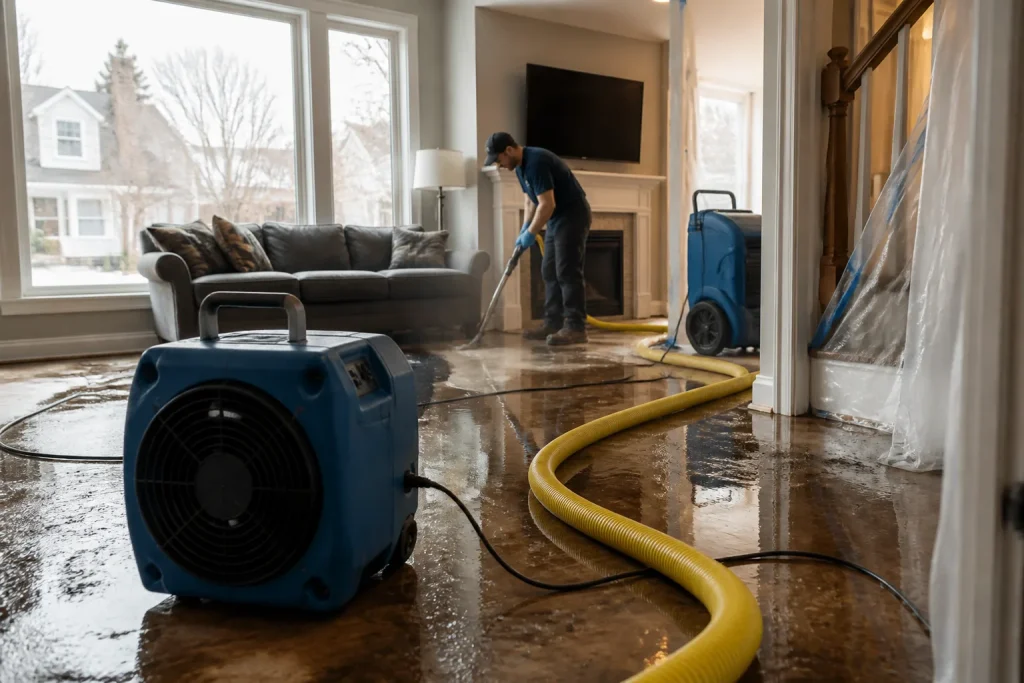
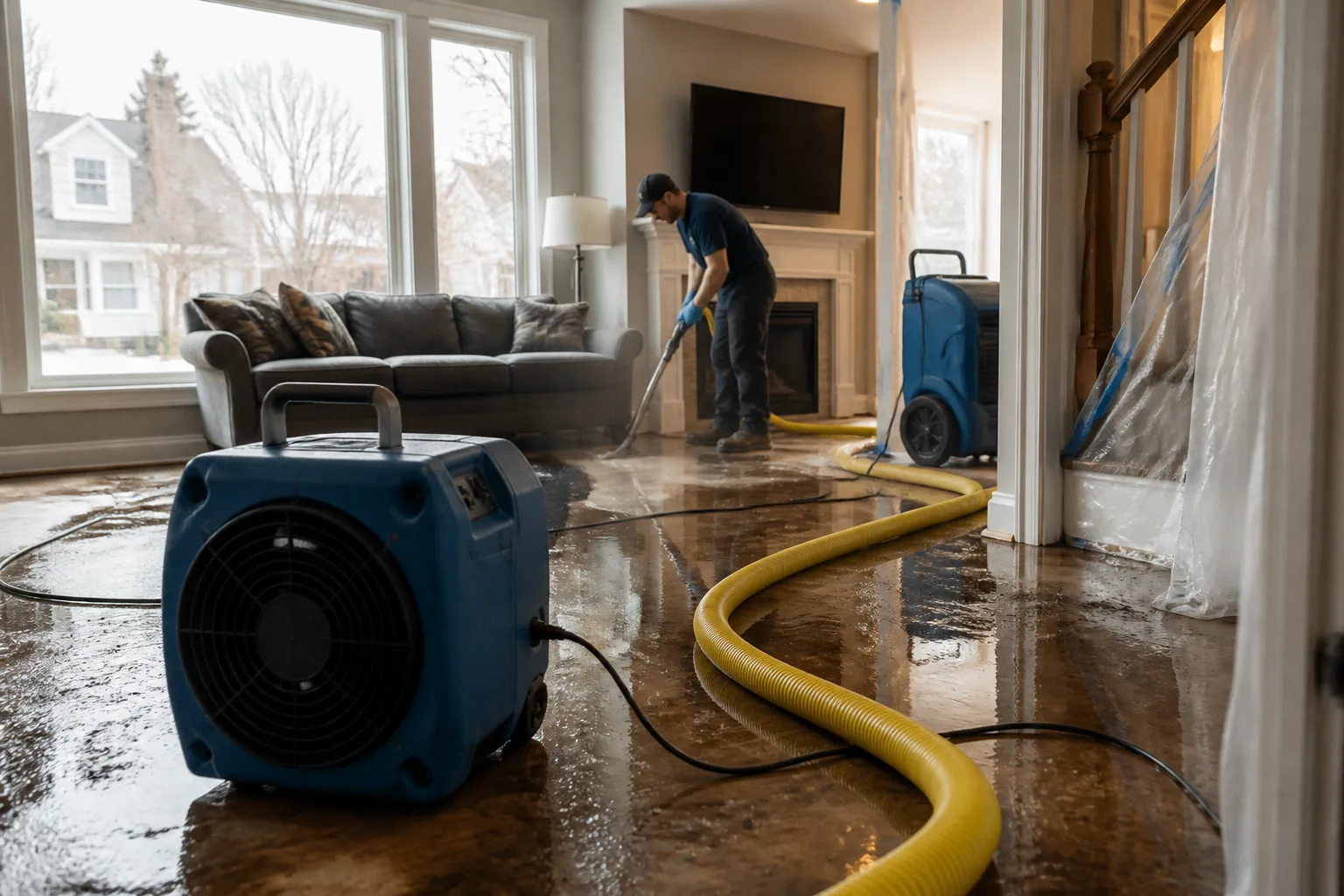
- Equipment rental per day. Air movers, dehumidifiers, and floor drying mats. A Dri-Eaz dehumidifier rents around $55 to $90 per day. A typical Minneapolis basement needs 3 to 6 air movers plus a dehumidifier for 3 to 7 days. That’s $900 to $2,500 in equipment alone.
- Demolition and disposal per square foot. Removing wet drywall, carpet, pad, and baseboards runs $3 to $7 per square foot. If it’s plaster instead of drywall, multiply the labor, not the materials.
- Antimicrobial application. Usually $200 to $600 per affected area. This is non-negotiable for Category 2 and 3. For Category 1, some contractors skip it to save cost, and that’s a mistake you’ll smell six months later.
- Contents manipulation. Moving furniture and boxes out of the way, often $150 to $500 depending on how much stuff you have.
- Reconstruction. New drywall, paint, flooring, trim. This is where the final number can double. Basic reconstruction in Minneapolis runs $5,000 to $15,000 for a standard basement.
Those numbers are real ranges for Minneapolis in 2026. They’re not padded. They’re not stripped. They’re what a fair contractor bills and what an adjuster expects to see.
Why Two Legit Contractors Can Be $4,000 Apart
Here’s a scenario we’ve seen play out in Bryn Mawr, in Kingfield, in Longfellow. Homeowner calls two restoration companies. Both are IICRC-certified, both carry proper insurance, both have solid reputations. Company A quotes $6,200. Company B quotes $10,300. Same job. Same house. The homeowner assumes someone is crooked. Usually, neither is.
The difference is almost always scope interpretation. Company A is quoting to dry the bottom 18 inches of drywall in place with drying mats and call it good. Company B is quoting to cut out and replace the bottom 24 inches because they measured moisture wicking higher than 18 inches. Company A quoted a 3-day dry down with 4 air movers. Company B quoted 5 days with 8 air movers because they saw the floor is ceramic tile over concrete, which dries slow. Company A didn’t include baseboard replacement because they think they can save it. Company B charges to remove and replace because pressboard baseboard falls apart when wet, and they’d rather be honest about it now.
Both estimates are legitimate. One is optimistic. One is realistic. The problem is that the homeowner can’t tell which is which because nobody explained the scope assumptions behind the final number. When Wade quotes a Minneapolis water job, he walks through the line items and the scope assumptions. You see what’s being dried, what’s being removed, and what each decision costs. It takes an extra 20 minutes, and it’s the difference between a quote and a promise. Wade’s Restoration of Minneapolis gives you that same transparency whether you book the job or not. A free second opinion on any written estimate is exactly what it sounds like. If you’ve got a quote from someone else, call (888) 690-6095 and Wade will read it with you.
Minneapolis Housing Stock and the Hidden Cost Drivers
Minneapolis has some of the oldest housing stock in the Upper Midwest, and that age shows up in water damage estimates in ways homeowners don’t expect. A 1920s bungalow in Nokomis is a different job than a 2018 townhouse in Northeast, even with the same pipe burst.
Plaster walls are the big one. Cutting drywall is fast and cheap. Cutting plaster and lath is slow, dusty, and heavy. Demolition costs on plaster run 30 to 60 percent higher per square foot. Then there’s the lead paint consideration on pre-1978 homes, which adds containment and specialized disposal in some circumstances. Knob-and-tube wiring shows up in homes built before 1950, and if water gets into those cavities, you’re drying around wiring that wasn’t designed to coexist with moisture. Finished basements with carpet over concrete create a different drying challenge than bare concrete, especially in Minneapolis winters when indoor humidity drops and drying times stretch.
Frozen pipe bursts in Minneapolis also tend to happen in exterior wall cavities, not open basements. That means wall demolition, insulation removal, and sometimes plumbing repairs get added to the water damage scope. A burst supply line to an upstairs bathroom can run $12,000 to $20,000 by the time you factor in ceiling repair on the floor below. If you live in a 100-year-old house, your water damage estimate is going to look different than your neighbor’s newer place, and that’s not a contractor making things up. That’s the house telling the truth about how it was built.
One thing that doesn’t change with housing age: moisture readings. Wade takes them every single day and hands you the full log when the job is done. Almost nobody in the trade does that. He uses Dri-Eaz and Phoenix equipment, the same gear the insurance industry recognizes, and he documents everything for your adjuster. In older Minneapolis homes, those daily readings catch the problem walls that look dry on the surface but are still holding moisture at the baseplate.
How to Use Your Estimate With Your Adjuster
Most Minneapolis homeowners treat their restoration estimate like a medical test result: they glance at the bottom number and wait for the insurance adjuster to tell them what it means. That’s backwards. Your estimate is your negotiating tool, and the more you understand it, the better your outcome.
First, ask for the line-item breakdown. If a contractor hands you a one-page estimate with a single number and no detail, that’s a red flag. Xactimate estimates run five to twenty pages. You’re entitled to see every line. Second, compare the scope of work against the source of the water. If you had a clean water pipe burst, there should be no sewage-related line items. If you see antimicrobial charges and you had clean water, ask why. There might be a good reason, but you should hear it. Third, when the adjuster approves or denies something, ask them to point to the line item. This is where matters get specific. If the adjuster says they’ll pay for 3 days of dehumidifier rental but the contractor says it’ll take 5 days, that’s a line-item conversation, not an argument. Both sides can defend positions with documentation.
Wade deals with the adjuster directly. You’re never the one stuck relaying information between two sides. He’s been doing this since 2007, and his crews have seen every variation of Minneapolis water damage there is. He knows what adjusters will approve and what they’ll push back on, and he writes estimates that hold up under review. When something gets denied, he picks up the phone and talks it through with the adjuster, line by line. You get copied on the conversation. You’re not left wondering what happened.
What the 2026 Numbers Actually Mean for You
Here’s the plain-language version of what Minneapolis homeowners paid in 2026, based on the work we’ve quoted and completed.
- Small Category 1 leak, caught early: $1,500 to $3,500. This is a supply line leak under a sink in a bathroom with vinyl flooring. Extraction, minimal drywall cutting, 3 days of drying, base coat of antimicrobial.
- Finished basement, Category 1, moderate: $4,000 to $8,000. Water across 400 to 800 square feet of carpet and drywall, a few days of equipment, baseboard and drywall repair.
- Category 2 gray water, finished basement: $6,000 to $14,000. Washing machine overflow or sump backup with light contamination, carpet pad replacement, drywall removal, antimicrobial, reconstruction.
- Category 3 sewage backup: $10,000 to $25,000. Full affected area containment, removal of drywall, flooring, insulation, extensive antimicrobial treatment, reconstruction with new materials.
- Frozen pipe burst in exterior wall: $8,000 to $20,000. Demolition of wall cavity, plumbing repair, insulation replacement, drywall and paint, ceiling repair if it’s upstairs.
These ranges assume standard Minneapolis construction conditions and current 2026 material and labor costs. If your home has asbestos-wrapped pipes, lead paint, or structural rot discovered during demolition, the number moves. That’s why any responsible contractor gives you a written scope before work starts. If someone quotes you a hard number over the phone without seeing the water, walk away.
When to Call a Pro
Some water damage you can handle with a mop and a box fan. A bathroom spill. A dishwasher leak you caught while it was still running. But if water has been sitting for more than a few hours, if it touched drywall, if it soaked into carpet or pad, or if it came from anything other than a clean supply line, call someone who does this every day. Drying a wall cavity properly requires equipment that pulls moisture out of the structure, not just off the surface. A wall that feels dry can still be at 30 percent moisture content, and in a Minneapolis basement that turns into mold by spring. That’s a $300 problem becoming a $9,000 problem because you wanted to save the deductible.
If you’re in Minneapolis and dealing with water right now, here’s what to do. Call (888) 690-6095. A live person answers, 24 hours a day, every day. That person is often Wade himself. He can have extraction running inside the hour, and he’ll tell you over the phone whether it’s urgent or whether you can catch your breath. No trip charge inside Hennepin County. Seniors and veterans get 10 percent off, always. If you’ve already got an estimate from another company, he’ll give you a free second opinion on it. Related services in Minneapolis include Water Damage Restoration in Minneapolis, Mold Remediation in Minneapolis, and Fire & Smoke Damage Restoration in Minneapolis.
The Bottom Line
Water damage restoration pricing in Minneapolis isn’t a mystery. It’s a line-item structure built on Xactimate, driven by water category, square footage, equipment days, and the age of your house. Clean water in a newer home is the cheapest scenario. Sewage in an old finished basement is the most expensive. Two quotes can be $4,000 apart for legitimate reasons, and the only way to tell the difference is to read the scope, not just the total. If you’re in Minneapolis and need help, Wade’s Restoration of Minneapolis home is the local, owner-operated option. Free estimates, a written scope before work starts, and a 90-Day Done Right Promise on every job. Call (888) 690-6095 and you’ll get a live human, not a queue.
Frequently Asked Questions
How much does water damage restoration cost in Minneapolis in 2026?
Most Minneapolis water damage restoration jobs cost between $2,800 and $7,500 for Category 1 clean water damage in a finished basement. Category 3 sewage jobs run $7,000 to $25,000 depending on how far contamination spread and how much reconstruction is needed. Call (888) 690-6095 for an exact quote on your situation.
Will my insurance cover water damage restoration?
In most cases, yes, if the water damage was sudden and accidental, like a burst pipe or a failed water heater. Gradual leaks and neglect are typically not covered. Adjusters approve or deny based on the line items in the estimate, which is why a detailed scope matters. Wade deals directly with your adjuster so you don’t have to relay anything back and forth.
How fast can someone actually get to my house in Minneapolis?
If it’s an active water situation, a crew can be extracting within the hour. Wade answers his own phone, 24/7, and there’s no answering service. The faster water is removed, the less damage you’ll have, so call the minute you notice standing water or wet drywall.
Do I really need full restoration or just a good cleaning?
If water touched drywall, insulation, carpet pad, or any porous material, a cleaning won’t fix the moisture trapped inside the structure. Drying equipment pulls water out of cavities that look dry on the surface. In a Minneapolis basement, leftover moisture becomes mold in weeks. A professional moisture reading tells you what you actually need.
Written by Wade Ferris, Owner at Wade’s Restoration of Minneapolis, serving Minneapolis since 2007.
Need Damage Restoration Help?
Call Wade's Restoration of Minneapolis - licensed & insured, here with fast after-hours help in Minneapolis.
(888) 690-6095